
ASTM A795 Hot-Dip Galvanized Steel Pipe
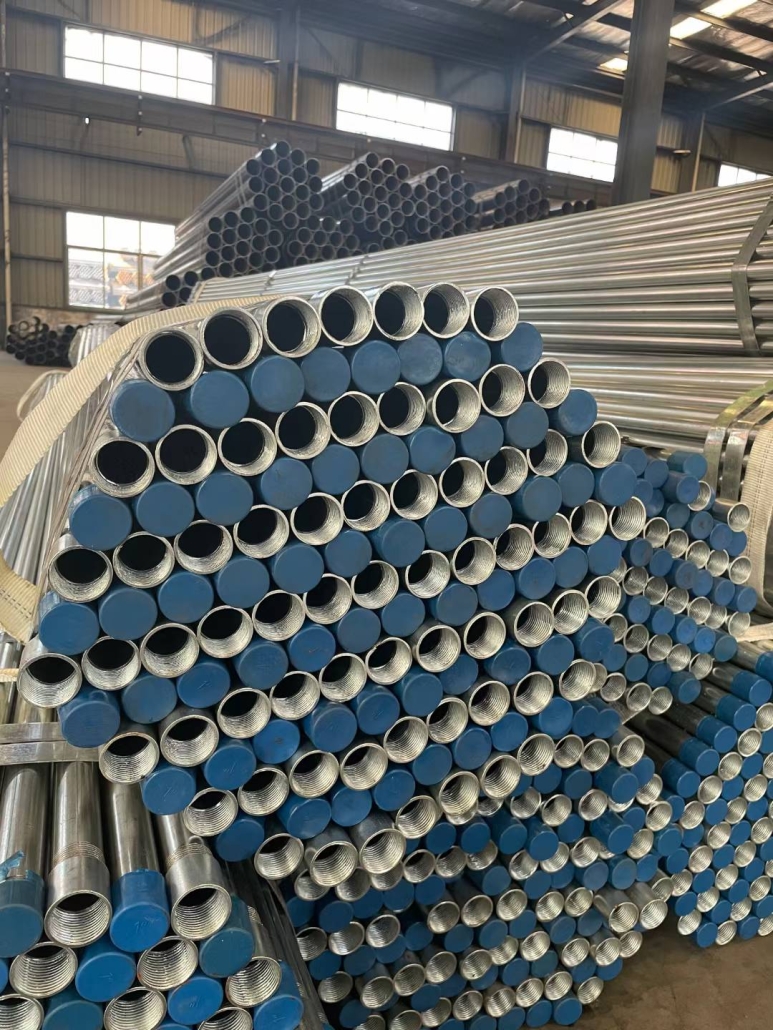
ASTM A795 is a dedicated carbon steel pipe standard for the North American fire protection industry, specially formulated for building automatic fire suppression systems. It covers both welded and seamless pipes. Unlike general-purpose fluid galvanized pipes, all performance, process and testing requirements of this standard are formulated for the core working conditions of fire protection systems, including long-term static service, instantaneous pressure bearing and anti-rust blockage performance.
The pipe specifications range from NPS 1/2 to NPS 10 (DN15–DN250), with mainstream wall thicknesses of Sch10 light-duty thin-wall and Sch40 standard pressure wall. It includes two steel grades, Grade A and Grade B. Grade B is widely adopted in building fire protection engineering due to its excellent toughness and crack resistance.
Mechanical property and welding stability are the core advantages of A795 pipes. Grade B pipes, the commonly used engineering type, adopt mandatory post-weld stress relief heat treatment at 540℃, which completely eliminates residual stress and brittle martensite structure in the welding zone. This effectively resists fire water hammer impact and long-term pressure fluctuation, avoiding weld cracking and leakage failures. Featuring balanced mechanical properties and excellent plasticity, the pipes are applicable to various construction methods including grooved clamp connection, threaded connection and on-site welding to adapt to complex on-site installation requirements. The standard stipulates a minimum bending diameter of 12 times the pipe outer diameter for cold bending to prevent peeling and tearing of the galvanized layer. All finished pipes undergo full-scale hydrostatic testing or non-destructive flaw detection to eliminate hidden leakage defects. With a conventional working pressure of 1.6 MPa, the pipes provide sufficient safety margin for emergency fire service conditions.
Corrosion resistance and durability are the key application highlights of galvanized A795 pipes. The pipes adopt full-range internal and external hot-dip galvanizing technology, forming a dense metallurgical bonding layer with the steel substrate, which delivers far higher adhesion than ordinary sprayed anti-corrosion coatings. The standard specifies a minimum galvanized layer thickness of 65 μm. Adopting dual protection mechanisms of physical isolation and sacrificial anode protection of zinc coating, the pipes effectively resist corrosion caused by atmospheric moisture, condensation, outdoor salt spray and mild soil erosion. The service life exceeds 20 years in dry indoor environments and reaches 15 years for outdoor overhead and semi-buried fire pipe networks, fundamentally solving common engineering problems such as pipeline rusting, scaling, sprinkler blockage and pipe leakage. Nevertheless, the pipes have application limitations and are not suitable for environments with long-term hot water above 60℃, strong acid and alkali, or high corrosive media, as high temperature will accelerate the failure of the zinc layer.
A795 pipes feature high machining accuracy and superior construction adaptability. Manufactured by ERW high-frequency welding technology, the pipes have smooth welds inside and outside with low inner wall resistance and stable fluid delivery performance, which accurately matches the hydraulic calculation parameters of fire protection systems and ensures stable water output efficiency of sprinkler systems. Light-duty Sch10 pipes are lightweight and easy to install, suitable for floor branch pipes and ceiling pipe networks. Heavy-duty Sch40 pipes with enhanced pressure resistance are applied to pump house main pipes, building risers and outdoor main pipe networks. With exclusive compliance with fire protection specifications, A795 pipes outperform ordinary A53 galvanized pipes and are the preferred material for fire protection projects in overseas commercial and industrial buildings.
In terms of engineering applications, A795 galvanized pipes are mainly used for wet, dry and pre-action automatic sprinkler systems in various buildings, including office buildings, commercial complexes, industrial plants, data centers and cold storage buildings. They are especially applicable to humid and corrosion-prone pipe networks such as basements, underground garages and outdoor overhead pipelines. Additionally, they are widely used for building fire risers, outdoor fire hydrant pipe networks and water pump adapter supporting pipelines, and can be extended to deliver low-pressure compressed air and conventional water supply and drainage with neutral low-pressure media. Weld damaged areas shall be repaired with zinc-rich coating in a timely manner to restore the anti-corrosion layer and ensure the overall durability of the pipe network.
Core Performance Parameter Comparison Table of ASTM A795 Galvanized Steel Pipe
| Performance Parameter | Unit | Grade A | Grade B |
| Minimum Tensile Strength | MPa | 483 | 414 |
| Minimum Yield Strength | MPa | 241 | 207 |
| Elongation After Fracture | % | ≥20 | ≥25 |
| Avg.Galvanized Layer Thickness | μm | ≥65 | ≥65 |
| Conventional Working Pressure | MPa | 1.6 | 1.6 |
| Core Process Characteristics | — | Conventional normalizing treatment | Post-weld stress relief heat treatment |
 Arabic
  English
  Dutch
Dutch  French
  German
  Italian
  Korean
  Spanish
اترك رداً
تريد المشاركة في هذا النقاششارك إن أردت
Feel free to contribute!