
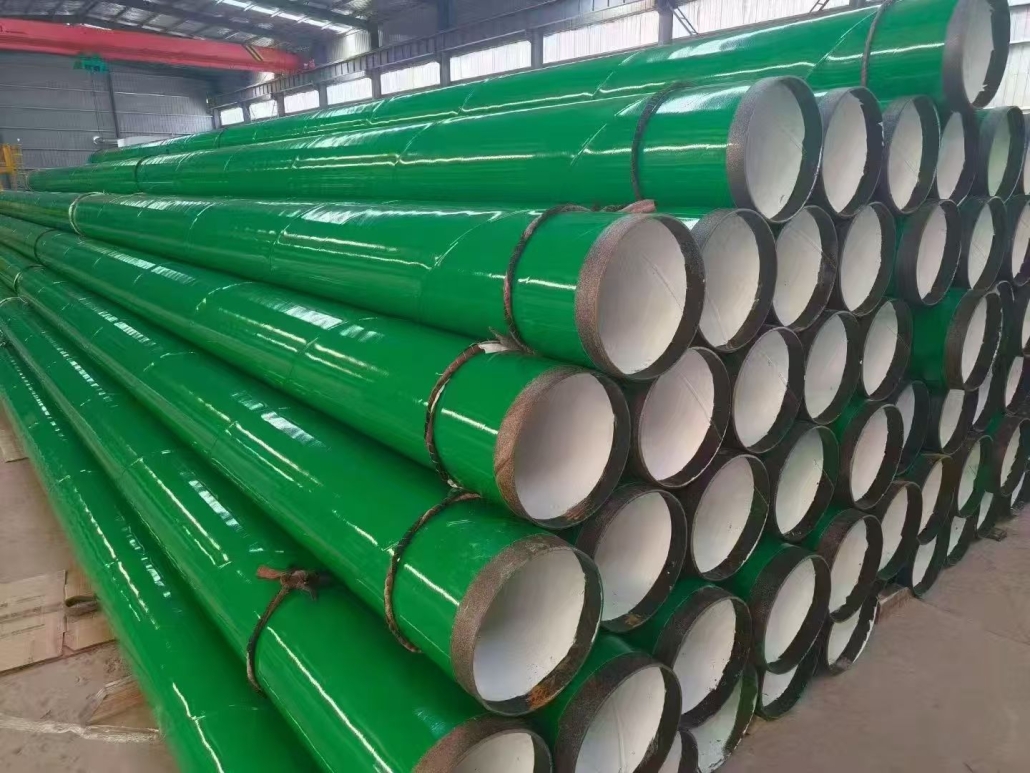
Phenolic Epoxy Painted Steel Pipes
Phenolic epoxy painted steel pipes are high-performance anti-corrosion pipes that form a dense protective layer by uniformly applying phenolic epoxy paint on the surface of steel pipes and curing it. They combine the strong adhesion and high corrosion resistance of epoxy resin with the high temperature resistance and solvent resistance of phenolic resin, making them the preferred pipe type for corrosive working conditions in the industrial field.
Core Characteristics
The core advantages of phenolic epoxy painted steel pipes stem from the composite properties of the paint, which balance protectiveness and practicality and avoid performance loss caused by excessive coating. The details are as follows:
Excellent Anti-corrosion Performance: The paint has a high crosslinking density, forming a dense protective barrier that can effectively block the penetration of corrosive media such as water, oxygen and chloride ions. It has good tolerance to weak acids, weak alkalis, organic solvents, crude oil, industrial wastewater, etc., and is suitable for most conventional corrosive working conditions. Long-term protection can be achieved without excessive coating thickness.
Adaptable to Medium and High Temperature Working Conditions: It can withstand a long-term temperature of 120-150℃ and a short-term temperature of 180℃, which is better than ordinary epoxy paint (≤100℃). It is suitable for medium and high temperature medium transportation. When the coating thickness is reasonable, cracking and peeling at high temperatures can be avoided.
Excellent Mechanical Properties: The coating adhesion is ≥4MPa (pull-off method), the flexibility can reach 1mm bending without cracks, the impact strength is ≥4J, and the wear resistance is outstanding. It can withstand slight mechanical stress during pipe installation and transportation. Excessively thick coating will instead reduce flexibility and increase the risk of cracking.
Construction and Environmental Adaptability: It is divided into solvent-based and solvent-free types. The solvent-free type has low VOC emissions and is suitable for construction in confined spaces. It can be cured at room temperature or medium temperature (60-80℃), and complete curing takes 7 days. After curing, the coating hardness is ≥2H (pencil hardness), which is convenient for construction and does not require excessive coating thickness.
Strong Functional Adaptability: It has good electrical insulation (can be used with cathodic protection) and microbial corrosion resistance (suitable for sewage treatment). The food-grade formula can meet the hygiene requirements of drinking water pipes (complying with GB/T 17219 standard), and the corresponding functions can be achieved when the coating thickness meets the standard.
Standard System
The production, paint selection, construction and acceptance of phenolic epoxy painted steel pipes must strictly follow national, industrial and international standards. Among them, the requirements for coating thickness are clear to eliminate excessive coating specifications. The core standards are as follows:
| Standard Category | Standard Number | Core Content (including coating thickness requirements) |
| Paint Standard | HG/T 3656-99 | Technical requirements for epoxy phenolic anti-corrosion primer, clarifying the control range of primer dry film thickness and eliminating excessive thickness |
| Paint Standard | SH 3022-99 | Technical requirements for epoxy phenolic anti-corrosion topcoat, specifying the matching thickness of topcoat and primer to avoid excessive superposition |
| Pipe Standard | GB/T 28897-2021 | Steel-plastic composite pipes and fittings for fluid transportation, clarifying the upper limit of dry film thickness of phenolic epoxy coating and standardizing thickness deviation |
| Construction and Acceptance | GB 50727-2011 | Construction quality acceptance of anti-corrosion projects for industrial equipment and pipelines, clarifying the coating thickness detection method and qualification judgment |
| International Standard | NACE RP0394 | Fusion-bonded epoxy coating standard, specifying the reasonable thickness range and uniformity requirements of phenolic epoxy coating |
Core technical indicators (related to coating thickness): Adhesion ≥4MPa (GB/T 5210 pull-off method), salt spray resistance 720h without blistering and peeling (GB/T 10125), coating thickness uniformity deviation ≤±10μm. Excessively thick coating will lead to non-compliance of these indicators.
Application Scenarios
The application scenarios of phenolic epoxy painted steel pipes focus on medium corrosion and medium-high temperature working conditions, and the protection requirements can be met without excessive coating thickness. The core application fields are as follows:
Petrochemical Industry: Ordinary crude oil transportation pipelines, normal temperature/medium temperature pipelines in refineries, and chemical medium (non-strong corrosion) transportation pipelines. The medium corrosion can be resisted when the coating thickness meets the standard, and no thickening is needed.
Power Industry: Auxiliary pipelines for desulfurization and denitrification in thermal power plants, turbine cooling water pipelines, and normal temperature flue gas pipelines. They can resist corrosion from sulfur-containing wastewater and ordinary flue gas, and reasonable thickness can avoid high-temperature cracking.
Water Treatment Field: Aeration pipelines in sewage treatment plants, municipal sewage transportation pipelines, and ordinary tap water pipelines. They are resistant to microbial and high-salt wastewater corrosion, and the food-grade coating can meet hygiene requirements when the thickness meets the standard.
General Industrial Field: Supporting pipelines for machinery manufacturing, plant ventilation pipelines, and ordinary underground buried pipelines (used with cathodic protection). They are suitable for conventional corrosive working conditions and do not require excessive coating thickness.
Light Industry Field: Material transportation pipelines in food and beverage processing plants. Food-grade phenolic epoxy coating is adopted, and the thickness meeting the standard can ensure hygiene and safety. Excessive thickness will instead increase costs without additional benefits.
Coating Thickness Control
Coating thickness is the key to determining the anti-corrosion effect and service life of phenolic epoxy painted steel pipes. Excessive thickness will lead to coating cracking, decreased adhesion and increased costs. The principle of “meeting standards on demand and uniform control” must be strictly followed. The specific requirements are as follows:
Standard Reasonable Thickness Requirements (Core Correction)
| Application Scenario | Coating Type | Dry Film Thickness (DFT) | Executive Standard |
| Ordinary transportation pipelines (water, ordinary media) | Single-layer phenolic epoxy paint | 80-120μm | GB/T 28897-2021 |
| Chemical medium corrosion pipelines (weak acid and weak alkali) | Double-layer (primer + topcoat) | 150-200μm (primer 60-80μm, topcoat 90-120μm) | GB 50727-2011 |
| Drinking water pipelines (food-grade) | Double-layer food-grade coating | Inner wall 120-150μm, outer wall 100-120μm | HG/T 4337-2012 |
| Underground buried pipelines (used with cathodic protection) | Fusion-bonded phenolic epoxy | 180-220μm | NACE RP0394 |
| Medium and high temperature pipelines (120-150℃) | High-temperature resistant phenolic epoxy | 150-200μm | SH 3022-99 |
Thickness Deviation and Uniformity Requirements
Follow the “two 90% principles”: more than 90% of the measuring points have thickness meeting the design value, and the remaining measuring points have thickness not less than 90% of the design value; the maximum thickness shall not exceed 120% of the design value (eliminating excessive thickness), and the minimum thickness shall not be less than 80% of the design value; the pre-coating thickness of special parts such as corners and welds shall be consistent with the main body to avoid local excessive or insufficient thickness.
Detection Method
Non-destructive testing is carried out using a magnetic thickness gauge (for ferromagnetic substrates), with 5-10 points tested per 1-2m², in accordance with GB/T 13452.2; the arbitration method adopts the cross-section method to verify the actual thickness and uniformity of the coating; during construction, the thickness shall be tested after each coat of coating is applied, and the next construction can be carried out only after meeting the standard to avoid excessive superposition.
The core advantage of phenolic epoxy painted steel pipes is “precise protection and adaptation to working conditions”, which can achieve 10-15 years of long-term anti-corrosion without excessive coating thickness. The key to its performance is to strictly control the coating thickness within the reasonable range of 80-220μm, select the appropriate coating type and thickness according to the application scenario, and at the same time follow the relevant standard requirements to ensure that the coating uniformity and adhesion meet the standards. Excessively thickening the coating will not only increase production costs, but also reduce the coating flexibility, easily leading to problems such as cracking and peeling, which will instead affect the protection effect.
 Arabic
  English
  Dutch
Dutch  French
  German
  Italian
  Korean
  Spanish
اترك رداً
تريد المشاركة في هذا النقاششارك إن أردت
Feel free to contribute!