
Construction Technology Of Coal‑Tar Epoxy Anticorrosive Steel Pipe
Applicable Industry Standard: SY/T 0447‑2014 Technical Standard for Epoxy Coal‑tar Anticorrosive Coating of Buried Steel Pipelines
The whole process consists of five stages: Factory Pre‑fabrication of Anticorrosive Coating → Hoisting & Welding of Pipes → Field Joint Coating & Repair of Damages → Pipe Lowering and Backfilling in Trench → Completion Acceptance
Construction Environmental Requirements
Construction temperature: 5‑40℃; Low‑temperature curing coating shall be adopted when ambient temperature is below 5℃.
Air humidity: Relative humidity ≤ 85%; The steel pipe surface temperature shall be 3℃ higher than the dew‑point temperature.
Open‑air anticorrosion work is forbidden in rainy, snowy, foggy weather or when wind force reaches Grade 5 or above.
Procedures for Factory Pre‑fabrication of Outer‑wall Anticorrosive Coating
Steel Pipe Surface Derusting (Quality Control Point)
Derusting grade by sandblasting / shot blasting: Sa 2.5, anchor profile depth: 40‑70 μm.
Remove rust, mill scale and oil contamination; Grind weld beads and burrs smoothly. Where weld reinforcement>2 mm, putty shall be applied for smooth transition afterwards.
The primer shall be applied within 8 hours after derusting to prevent rerusting of steel pipe.
Leave bare sections of 150‑250 mm at both pipe ends without anticorrosive coating for field welding.
Coating Mixing
Coal‑tar epoxy paint is a two‑component material (primer, topcoat + curing agent)
Mix base material and curing agent thoroughly in the ratio specified by the manufacturer.
Stand and age for 10‑30 minutes.
The maximum dosage of thinner shall not exceed 5 %; No thinner is allowed for solvent‑free coatings.
Mixed paint shall be consumed within its pot life; discard expired cured paint.
Painting and Fiberglass Winding (Three Anticorrosion Grades)
Use dewaxed medium‑alkali fiberglass cloth.
Ordinary grade (no cloth): Primer → Topcoat → Topcoat → Topcoat, minimum thickness ≥400 μm, spark test voltage 15 kV
Reinforced grade (one‑cloth‑two‑coat): Primer → Topcoat → Wind fiberglass cloth → Topcoat → Topcoat, minimum thickness ≥600 μm, spark test voltage 15 kV
Extra‑reinforced grade (two‑cloth‑three‑coat, most commonly adopted in municipal engineering): Primer → Topcoat → Wind cloth → Topcoat → Wind the second layer of cloth → Topcoat, minimum thickness ≥700 μm, spark test voltage 20 kV
Technical Parameters for Cloth Winding
Stretch fiberglass cloth tightly, free of wrinkles and hollow blisters.
Circumferential overlap width: 20‑30 mm; Longitudinal overlap: 100‑150 mm.
Fiberglass mesh shall be fully saturated with topcoat, no dry yarn is permitted.
Curing and Maintenance
Natural curing at ambient temperature, fully cured in 7 days. Protect coating from rain, collision and direct sunlight during curing (Asphalt layer will crack and pulverize under ultraviolet radiation).
Factory Inspection
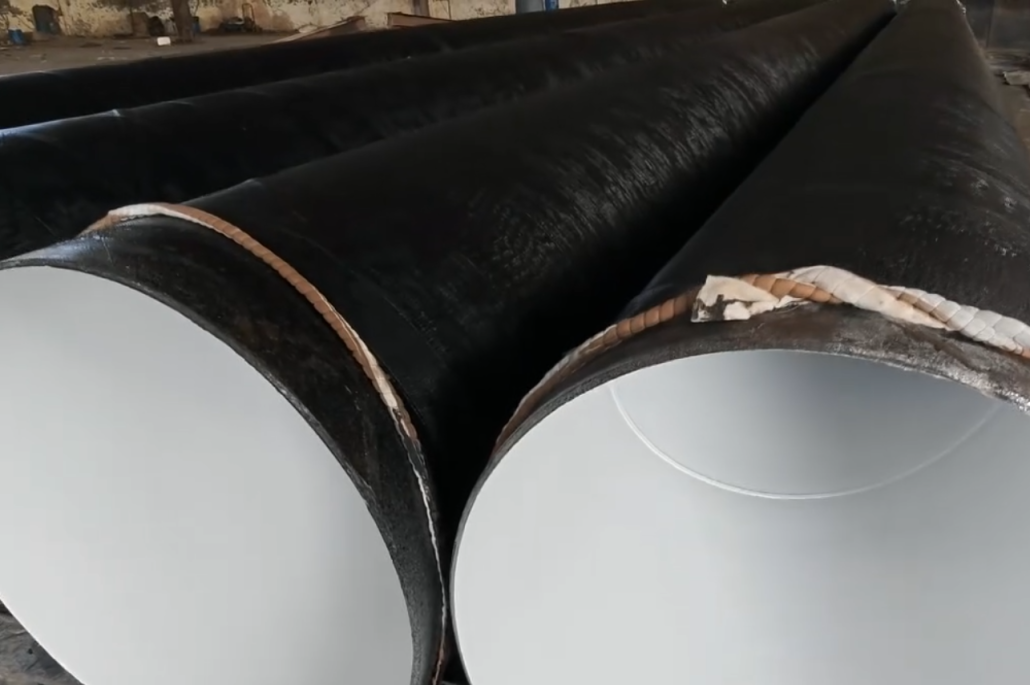
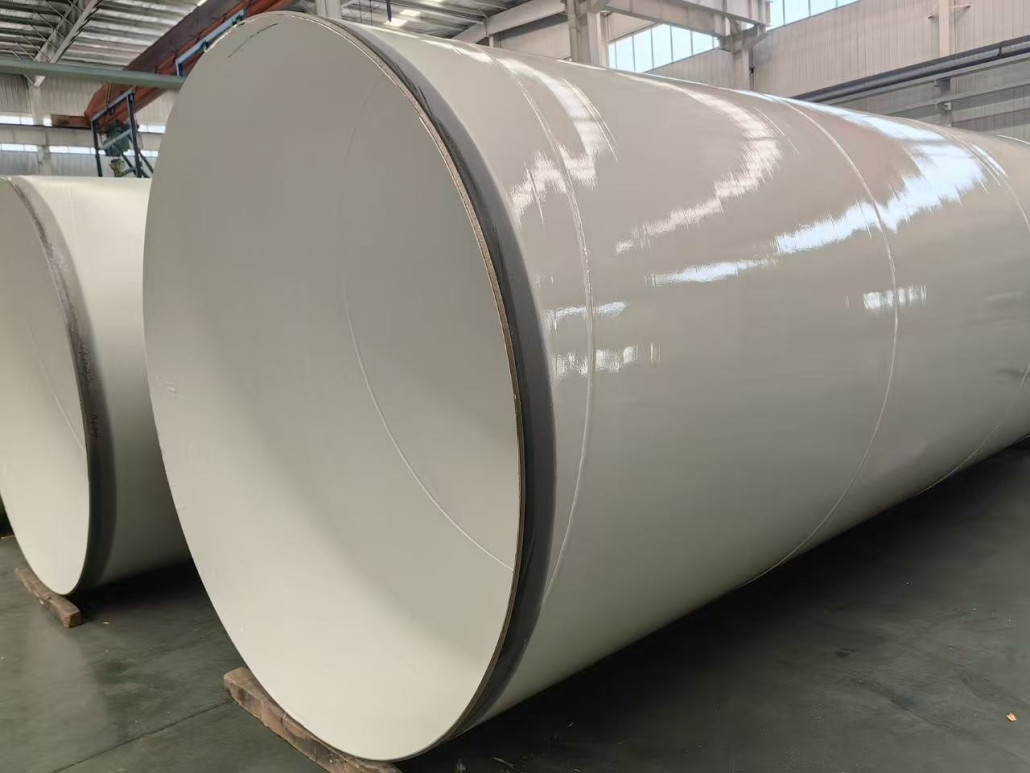
100 % visual inspection: Smooth and glossy black coating, free of bubbles, hollowing, sagging and holidays.
Measure dry‑film thickness with magnetic thickness gauge.
Holiday detection by spark tester (mandatory), no pin‑hole defects.
Sampling cross‑cut adhesion test with qualified result.
Field Welding and Installation of Steel Pipes
Pipe hoisting and transportation: Use soft slings; Steel wire ropes shall not scratch anticorrosive coating directly.
Butt‑weld the pipes and complete weld inspection. Do not carry out joint anticorrosion work until welds cool down fully to ambient temperature.
Field Joint Coating & Damage Repair (High‑frequency Defect‑prone Positions on Site)
Weld‑joint Coating
Anticorrosion structure and grade shall be identical to that of pipe body.
Derusting: Sandblasting to Sa 2.5 is preferred; Manual derusting to minimum St 3 when site condition is restricted.
Roughen the end of original anticorrosive coating by sandpaper; The overlap between new and old coating ≥100 mm, finished in stepped lap shape.
Construction sequence is exactly the same as factory prefabrication: Primer → Topcoat → Fiberglass cloth → Topcoat …
Spark holiday test is required after joint coating completion.
Repair of Damaged Anticorrosive Coating
Where steel substrate is exposed at damaged spot: Grind for derusting → Apply primer → Restore original coating layers with cloth and topcoat.
Where only surface coating is damaged without exposed steel: Polish old coating surface → Patch topcoat, overlap width ≥100 mm.
Pipe Lowering and Backfilling Construction
Lower the pipe into trench only after coating is surface‑dry. Dragging pipes is forbidden to avoid coating damage.
Lay 200 mm fine loose soil at trench bottom; No stone or sharp hard objects are allowed inside the trench.
Backfill fine soft soil within 300 mm above the pipe crown. Crushed stone and bricks shall not contact the pipe directly; Original soil backfilling can be implemented afterwards.
Completion Acceptance Items
100 % visual inspection for anticorrosive coating appearance.
Sampling inspection on dry‑film thickness of anticorrosive layer.
Full‑line spark holiday detection (core acceptance item).
Sampling adhesion test.
As‑built documents: Factory certificate, inspection reports, field joint‑coating construction records.
Common Construction Quality Defects & Prevention Measures
Unsaturated fiberglass cloth → Hollow blister & delamination: Apply topcoat immediately after cloth winding; No dry cloth allowed.
Rerusting after long‑time exposure post‑derusting: Apply primer within 8 hours after derusting.
Insufficient overlap width at repaired joints: Maintain overlap ≥100 mm.
Rainfall and sunlight exposure before full curing: Provide covering protection during construction.
Reduced cloth layers and insufficient coating thickness: Adopt dual control measures: spark holiday test + dry‑film thickness measurement.
 French
  English
  Arabic
  Dutch
Dutch  German
  Italian
  Korean
  Spanish